

Yes, workshops can and should be fun. A game for stakesholders to look forward to your invitation mails (or at least not sort it directly in a paper bin).
Card packs below!
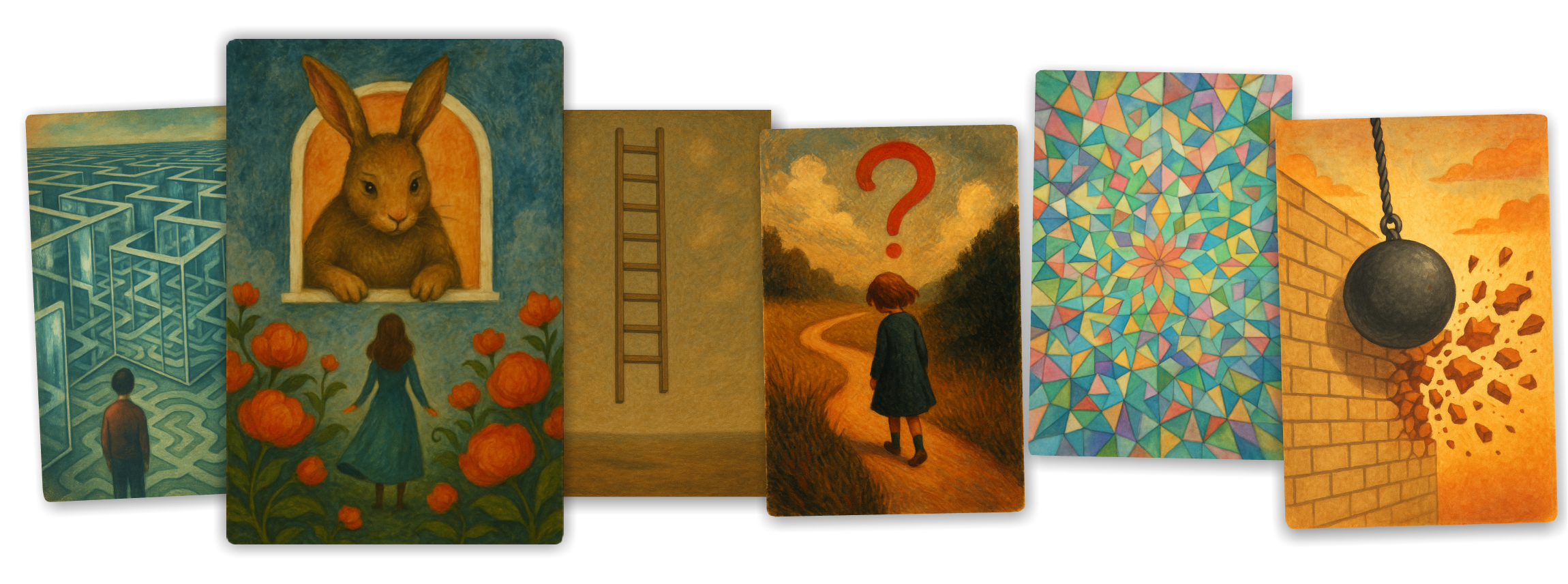
One can hardly find a less playful setting than Stockholm’s corporate environment with sustainability focus. And the initial vibe was that, even though our participants were coming from different cities and different organizations. Dixit-ish cards increased the engagement, contributed to a more relaxed and informal environment - and at some point people were sharing jokes and smiling at familiar stories from working life.
And that in a zoom call!
We’ve been holding a series of workshops making small modifications based on participants’ feedback and our feeling from the previous ones. The setup will certainly evolve and change, but the last version was definitely a success.
How it works
The workshop is divided into three parts: introduction, core, conclusion.
Duration: 90 minutes focus window.
Setup: digital (can as well be in-person or hybrid, in-person preferred)
Equipment:
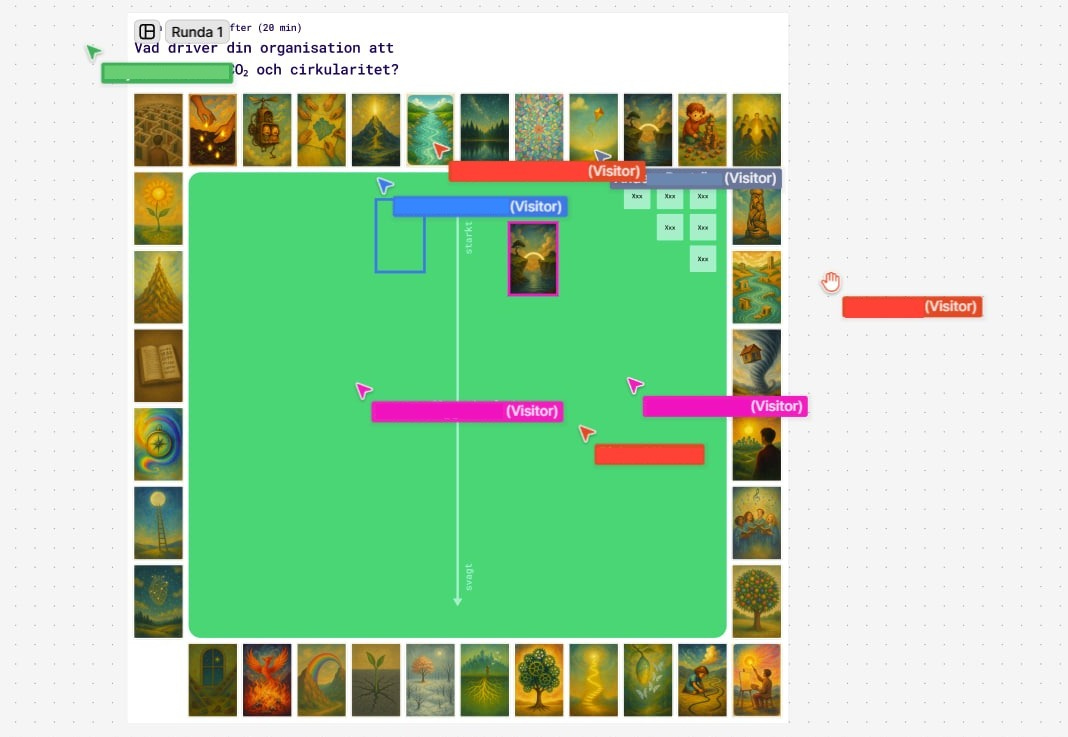
Figma / Miro / physical canvas
cards (either digital or physical)
Process:
Explaining game rules
Icebreaker game round with participant introduction
Short intro to the core workshop topic
Three core game rounds
Conclusion
Preparation: prepare the core questions to ask the stakeholders. A good question can be answered with a range (not Y/N) and you would expect most people to say “it depends”. The aspects of it depends is exactly what you want to capture during the workshop.
Print the cards or place them on the digital canvas. Draw the opinion space for people to place the cards onto. Opinion space is usually defined by a number of axes (easy-difficult, worst-best).
Make an internal test of the workshop with friends / co-founders to make sure everything works as intended, from questions to technology.
And ready to go!
Game round
Ask an open question, start a timer.
During these 5 minutes participants should choose the card that reflects their opinion and feelings on the question best and position it in the opinion space, along the defined axes. When the time is up, everyone explains their cards.
At the end we start the timer again, 30 seconds this time. Participants should vote for the card that most people would vote for. Guessing right gives you all the points from the card you voted for (note: not your card, the one you voted for!).
The one with most points in the end of the game wins🍾
Making it fun
Introduction is usually the most boring part of the workshop with the usual round the table introductions. After the first event (that was hold exactly this way) we realized that it makes us loose precious time. Instead Aksel Alvarez suggested we combined it with the first game round. Everyone gets acquainted in a fun way and understands the rules for the following core part - win-win!
Core part wouldn’t be fun without a challenge or a competition. Using the classic Dixit rule - guessing which card would be approved by the most stakeholders in the workshop gives it a little twist:) Collecting points is a classic engagement strategy and guessing the public opinion gives a hint of general mood in the field.
Still imperfect
Since the aim of the workshop is to collect subjective data from the experts in the sector, it is hardly quantifiable. One of the comments we’ve got was regarding the summarization:
How are you going to summarize this if there are no numbers associated to our words?
It’s still a challenge. There is no automating of data extraction and, as it was noticed, no numbers involved. This is often the case with qualitative data. Having opinion space, however, allows us to see where the sector is leaning to. We can also evaluate the relative positions of different actors, with respect to one another and the average.
And, of course, decentralized engagement is still something to work on. Ideally participants should be able (and willing) to mingle and share their ideas. Willingness is challenging even in in-person workshops, let alone remote meetings.
And what about LCA and CO2?
There will be a series of posts on our findings and results from the workshops. And a detailed description of our workshop.